AI / Public safety
Synclair Vision: Training AI on synthetic data
Synclair Vision is a university spin-off from Linköping, started by newly graduated engineers. The company develops camera systems for drones that combine wide-angle optics, real-time AI analysis and depth perception. The AI stabilises the image digitally, so the drone needs no heavy gimbal. That means lighter payloads for surveillance, infrastructure monitoring and wildfire detection.
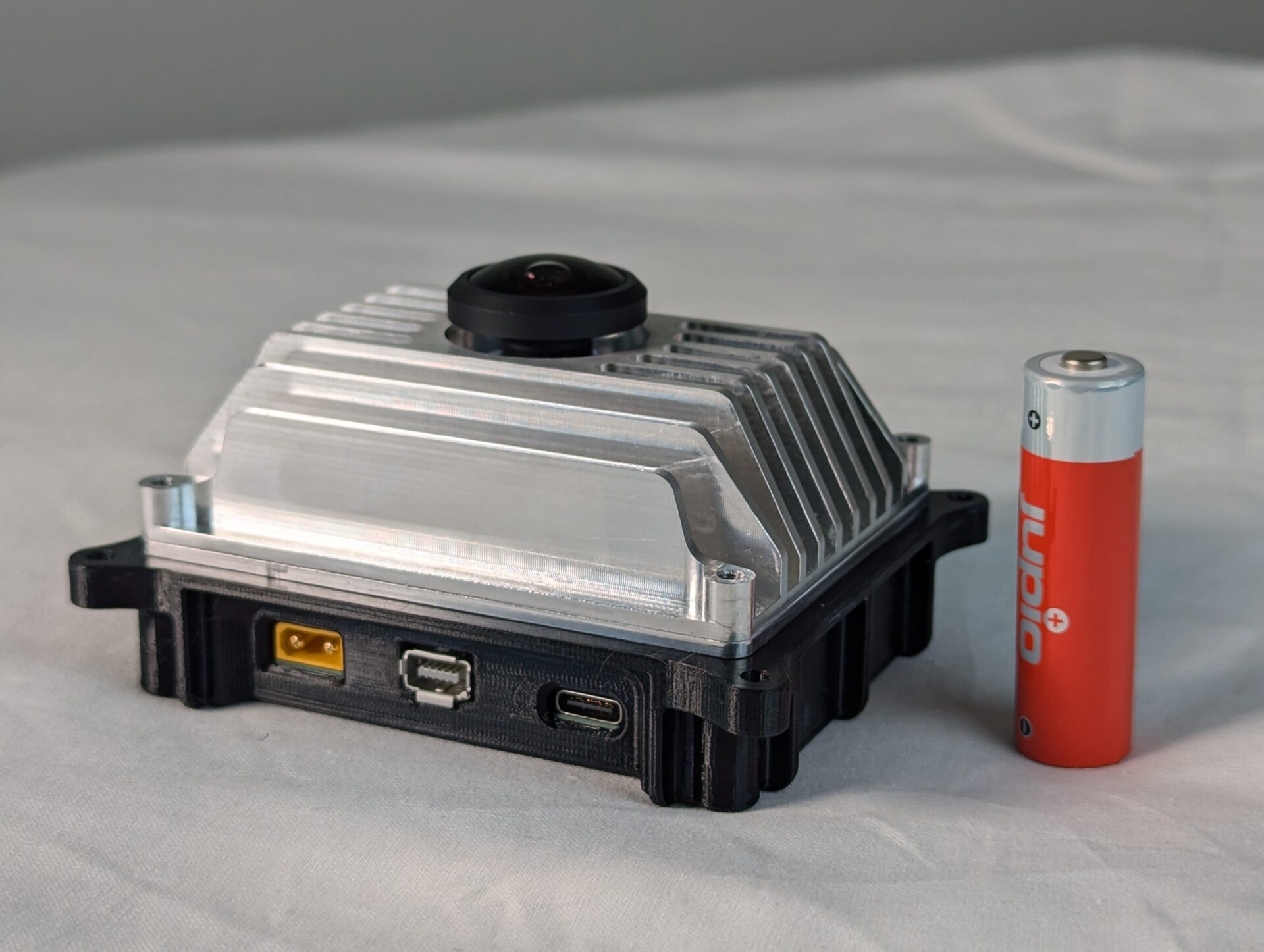
The technology attracted interest early on, but the team had no demonstrator to show it working and no experience of applying for funding.
Aero EDIH supported Synclair Vision in two steps:
Finding the funding
Together with Aero EDIH, the team wrote an investment proposal that brought out the technical strengths and market potential. It led to two grants from Vinnova: 413,500 SEK followed by 1,300,000 SEK. With that money they built a fully working prototype and grew the team.
Training the AI faster
Through Test Before Invest, ModulAI built an Unreal Engine 5 environment that generates large volumes of annotated training images. Test flights with RISE in Linköping added real-world data. This removed the need for slow, costly manual data collection.
The result
The result is a demonstrator to show customers and investors, AI models trained on both simulated and real data, and a clear path towards commercial use. Synclair Vision’s digital maturity score rose from 39% to 70% over the course of the support.
“As a startup company consisting of only newly graduated students, it has been difficult to understand and apply for soft funding. Coming in contact with Aero EDIH and being granted funding for support to find investment was a big game changer for us.”
Carl Wikström, CEO, Synclair Vision
AI / Forestry
Nordluft: from drone prototype to precision forestry
Nordluft Automation builds heavy-lift drones that spread fertiliser over forest and farmland. A whole fleet is flown autonomously by the company’s own control system, NGC (Nordluft Ground Control). The prototype worked, but it wasn’t yet precise or robust enough for real operations.

Through Aero EDIH, Nordluft ran three development projects, starting in 2024:
A leaner control system
Vehicle handling moved from small computers inside each drone to the ground station. The result is fewer parts, less maintenance and more autonomous missions.
Centimetre-level precision
RTK GPS was integrated across drones, base station and software. This precision is critical when drones land and refill, and it lays the groundwork for the flight permit process.
Finding the right tree
Together with SLU, Nordluft tested a drone in forest north of Uppsala. It flies to a target tree, recognises it with a stereo camera and AI, and lowers itself to about one metre above the treetop to release a precise dose of nutrients.
The result
The control system is now practically usable for commercial operations. It is ready to go into service once flight permits are granted by the Swedish Transport Agency. Targeted fertilisation of young trees has been shown to work in real forest conditions, which means less nitrogen leakage and better survival for young trees.
“The support from Aero EDIH meant that Nordluft could take the first steps in the development of a family of new very exciting forestry applications for drones.”
Elof Winroth, Founder, Nordluft Automation
Simulation / Public sector
Region Skåne: planning the drone airspace of 2030
Region Skåne is one of the first two places in Sweden designated for U-space, the EU framework for managing drone traffic. The region wanted to understand what drone logistics could look like by 2030, especially for healthcare. Lab samples, blood and medicines are small, frequent and time-critical deliveries. The flights also have to fit around airports, ambulance helicopters, nature reserves and people’s homes.

Through Aero EDIH, Naviation AB ran a workshop and a series of airspace simulations for two areas, Malmö–Lund–Sturup and Kristianstad–Hässleholm.
What we did
The team drew drone corridors that avoid sensitive places such as nature reserves, sports grounds and cemeteries. They also extended the corridors so that smaller towns along the way get access to the service. The simulations showed how airspace near Sturup Airport can open and close for drones as manned aircraft come and go.
The result
The simulation gives Region Skåne a realistic picture of the drone traffic to plan for. About 430 delivery flights a day around Malmö and Lund would sit well within the airspace’s capacity. The region received a report, a video and map files of every corridor and zone. Municipalities can use them directly in their own planning.
One lesson stood out. In Skåne, the value of drones in healthcare is less about speed and more about reliability, sustainability and equal access to care.
“The U-space simulation contributes to a more concrete and practical understanding of the future development of drones in Skåne. It opens up new possibilities and highlights the work that remains to be done before the introduction of U-space.”
Rocky Cueva Alban, Regional Community Planner, Region Skåne
Simulation / Public sector
Norrköping Airport: simulating a drone link to Gotland
Gotland has no fixed link to the mainland. Most goods travel by scheduled flights and ferries, and anything urgent, such as a medical sample or a spare part, has to go by helicopter, which is expensive. Drones could fill that gap, but a route between Gotland and Norrköping crosses open sea, much of it international waters. Before anyone flies it for real, it has to be clear whether it can be done safely and what stands in the way.

With funding from Aero EDIH, space2ground Consulting AB and Norrköping Airport ran a study in autumn 2025, as a first step towards a drone corridor between Norrköping and Visby.
What we did
The team simulated two flights based on situations handled without drones today. A drone carries an urgent medical sample from Visby Hospital to Vrinnevi Hospital in Norrköping. Another takes off from Norrköping Airport to check a reported oil spill. When the flight paths came close, the system warned the environmental drone and steered it away, so the medical flight kept its priority.
The flights were modelled on Dufour Aerospace’s Aero2 and UMS Skeldar’s helicopter drone, and run in UTM City, a drone traffic simulator from Linköping University, together with tools from the research project Testbed Air Mobility. The team also ran a risk analysis using SORA, the European method for assessing drone operations.
At workshops in Visby and Norrköping, 45 people from healthcare, public authorities, logistics, industry and drone companies watched the simulation and worked out what it would take to start a real service.
The result
The risk analysis found the risk to be low and the safety targets met. The biggest obstacle is legal, not technical: Gotland is surrounded by international waters, and there are no rules yet for drone flights there. Dialogue with ICAO and EASA about an interim framework is ongoing.
Region Östergötland and Region Gotland, together with logistics and courier companies, agreed to keep working on concrete cases, with support from Science Park Gotland and Norrköping Science Park.
“This visualised drone simulation is only the beginning.”
Svante Swärd Rudström, Business Developer, Norrköping Airport
The project also involved Linköping University, RISE, Jetpak Group, Dufour Aerospace, Savback, UMS Skeldar, ACR, SO Visuals and Transportföretagen.